


AI Automation Guide: How Shopify Stores Are Saving 40+ Hours Weekly in 2025
AI automation is changing how we run online businesses. Tools like ChatGPT now cut professional writing tasks by 40% and improve output quality by 18% . These efficiency gains mark just the beginning of what Shopify store owners can achieve in 2025.
The data tells a compelling story. The global AI-enabled ecommerce market will reach $8.65 billion this year , and 77% of ecommerce professionals use AI daily . Merchants who implement AI workflow automation see their conversion rates jump by 22% on average . AI automation tools change operations for businesses through inventory management, customer service, and marketing. Doe Beauty saves $30,000 weekly and gains back four hours of human labor by using Shopify’s AI-driven automation services .
This piece shows you how to achieve these results with your Shopify store. You will discover practical AI automation examples that can save 40+ hours each week.
The rise of AI automation in Shopify stores
Shopify merchants see a major change in online store operations as AI automation reshapes the ecommerce scene. AI has grown from basic task automation into a key advantage for stores, regardless of their size.
Why 2025 is a turning point for ecommerce automation
The year 2025 marks a crucial point for ecommerce automation in the Shopify ecosystem. Businesses now compete based on process efficiency rather than just product offerings . Market projections show this clearly – the global AI market should reach £601.66 billion in 2025 , while AI-powered ecommerce could hit £6.87 billion .
Several key factors make 2025 a defining moment for Shopify automation:
AI automation now makes clear business sense. Research shows merchants using AI-powered personalization see their conversion rates go up by 22% on average . Stores that use predictive inventory management cut their carrying costs by up to £174,715 each year .
The tech foundation has grown stronger. AI development has moved faster since ChatGPT’s launch in late 2022. Now 67% of CEOs are planning to adopt AI projects that show clear returns . Small Shopify merchants can access sophisticated AI tools easily.
Customer needs have changed. About 51% of ecommerce businesses use AI to create individual-specific shopping experiences . This sets new standards that buyers now expect. AI will handle 80% of all customer interactions by 2030 , showing a basic change in how stores connect with shoppers.
Market pressure drives adoption. Ecommerce businesses have increased their AI adoption by 25% yearly since 2020 . This creates a growing gap between stores using AI and those falling behind. About 84% of ecommerce businesses now put AI at the top of their priority list .
These changes make AI essential rather than optional in 2025. One industry report states: “Adopting AI in e-commerce is not optional; it’s a strategic imperative driven by critical factors reshaping the competitive landscape” .
How AI automation tools are reshaping daily operations
AI automation tools change how Shopify stores work each day, touching almost every part of their business.
Inventory and Supply Chain Management
AI makes the biggest difference in inventory optimization. Modern AI systems look at sales history, market trends, sentiment analysis, and weather patterns to predict demand accurately . Shopify merchants can now:
- Set up automatic purchase orders when stock gets low
- Place inventory in the best locations across fulfillment centers
- Keep stock levels perfect – not too high or too low
Companies using AI in their operations cut inventory by 20% to 30% through better demand forecasting .
Customer Experience Enhancement
AI brings new ways for Shopify stores to work with customers:
AI-powered product suggestions can triple revenue, double conversion rates, and boost order values by 50% . These systems check browsing history, past purchases, and current behavior to suggest the right products for each shopper.
Modern AI support systems handle 70-80% of customer questions on their own . Smart chatbots understand feelings, goals, and context. They provide quick service and pass complex issues to human agents when needed.
Marketing and Content Optimization
AI turns marketing from manual work into a smart, data-driven system:
Smart email systems respond to specific customer actions like abandoned carts, birthdays, or browsing patterns . These programs create personal customer trips that adapt based on behavior, history, and intent.
AI tools like Shopify Magic now handle content creation faster. They write product descriptions, blog posts, and marketing copy much quicker than before .
Financial and Security Operations
AI automation makes financial tasks smoother and security stronger:
Smart systems spot fraud by checking transaction patterns and finding unusual activity right away . Store owners can act fast to stop fraudulent transactions.
AI-powered systems adjust prices based on market conditions, competitor prices, and customer behavior. This helps stores maximize profits while staying competitive .
Productivity Impact
AI automation boosts productivity significantly. Gartner reports that eCommerce companies using full automation saw 40% more productivity and kept 30% more customers within a year .
Small and medium businesses find AI helpful – 87% say it helps them grow . Growing SMBs use AI more often, with 83% adoption compared to lower rates in other segments .
Teams can now focus on strategy, solving problems creatively, building customer relationships, and creating new products instead of doing repetitive tasks . About 78% of SMBs using AI believe it will change their business completely .
AI automation does more than just improve how Shopify stores work – it opens up new possibilities for online merchants. The next sections show how specific AI automation examples help stores save 40+ hours weekly while giving customers better experiences and driving growth.
8 AI automation examples saving 40+ hours weekly
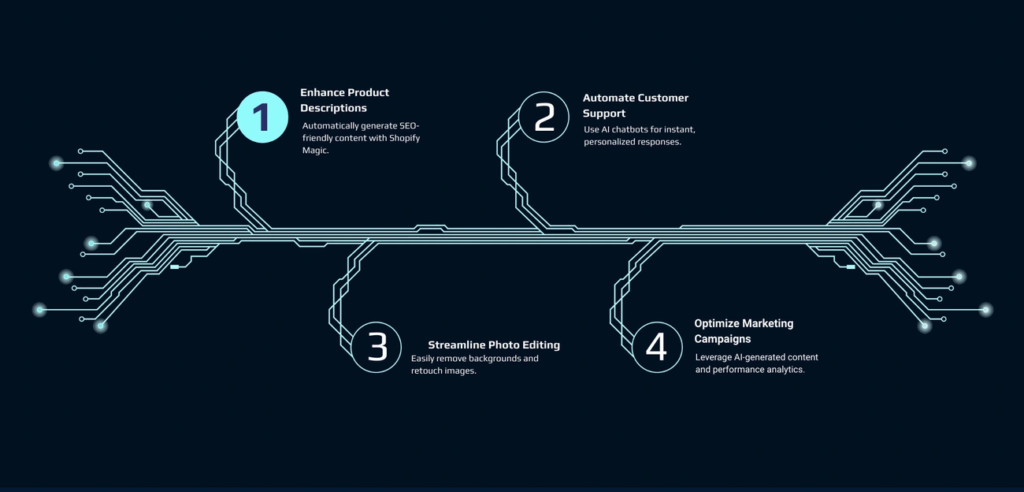
Here’s a practical guide showing how top Shopify stores use AI automation to significantly reduce workloads and boost productivity. These solutions are changing how ecommerce businesses operate in 2025.
1. Automated product descriptions with generative AI
Product descriptions play a vital role in customer decisions, yet millions of Shopify products lack proper descriptions. Shopify Magic now creates compelling product descriptions within seconds. Store owners list product details or target keywords, and the AI generates a description right on the product setup page .
The AI writer works across your entire catalog and maintains a consistent tone whatever the size of your product range . Merchants with large inventories save massive amounts of time. A task that previously took 20-30 minutes per description now takes just 2-3 minutes. Stores updating 20 products save 4-5 hours weekly .
This feature comes free with paid Shopify plans and works in multiple languages .
2. AI chatbots handling customer support 24/7
AI chatbots have become vital for modern customer service. About 80% of companies now use AI to improve customer experiences . These automated assistants work continuously and handle customer queries during nights, weekends, and peak sales periods when human agents aren’t available.
Companies see significant results. About 90% report faster complaint resolution after adding AI customer service chatbots. These bots now handle up to 80% of routine support tasks . Response times drop from minutes to seconds, which significantly improves key customer support metrics.
These intelligent systems can:
- Handle multiple customer queries simultaneously
- Process common requests like order tracking and returns
- Collect customer information for escalation to human agents
- Provide personalized product recommendations based on shopping history
- Businesses like Lush save about 5 minutes per ticket and 360 agent hours monthly .
3. Smart inventory forecasting and reordering
Managing inventory takes considerable time in ecommerce. AI-powered forecasting systems like StockPerfect analyze multiple factors at once—from seasonality patterns and price elasticity to marketing activities and weather patterns.
These AI systems calculate optimal levels based on product demand volatility, supplier lead times, and financial impact of stockouts, rather than using fixed safety stock percentages .
The numbers tell the story. Businesses using AI-powered inventory forecasting report 20-30% lower inventory holding costs, 15-25% fewer stockouts, 35-40% less obsolete inventory, and 80% time savings on forecasting and planning .
Some tools, like Forecast app, fully automate purchase orders. This saves merchants 8+ hours monthly while maintaining optimal stock levels .
How AI workflow automation boosts team productivity
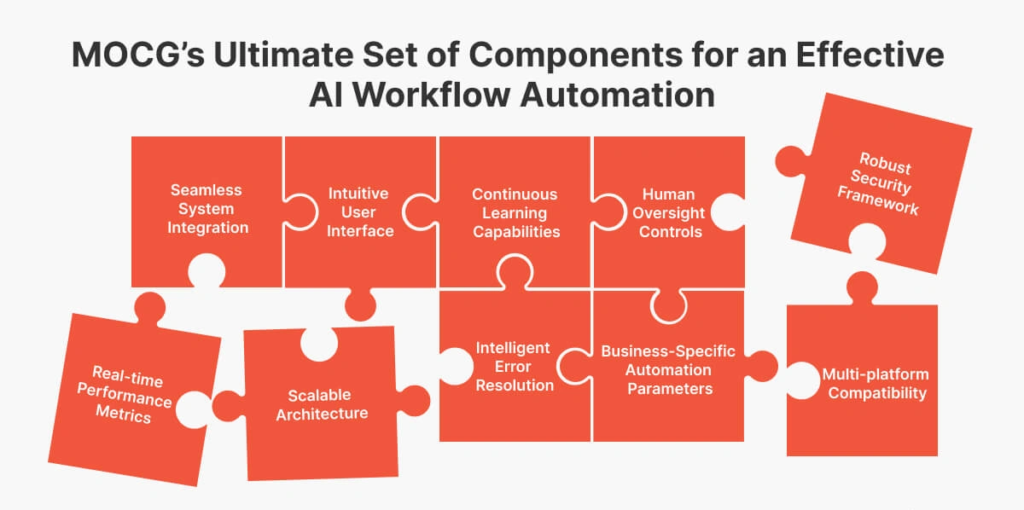
AI doesn’t just automate individual tasks – it revolutionizes entire workflows. Companies that use AI workflow automation see amazing productivity boosts throughout their operations. A Deloitte study shows smart automation can cut business process costs by 25% to 40% on average .
Reducing manual tasks across departments
AI automation saves Shopify stores countless hours by eliminating manual work that used to eat up team resources. Teams save time in several key areas:
Marketing teams thrive with AI tools that create product descriptions, social media posts, and email campaigns that match their brand voice. These systems schedule content and analyze data automatically, which saves hours of work . AI content tools can write product descriptions and edit images way faster than humans .
Customer service gets better too. AI chatbots now handle customer questions in multiple languages and give quick, accurate answers without human help . These smart tools get the context, understand questions, and tap into live data to create tailored responses . Many companies find their AI support tools can handle up to 80% of basic customer questions on their own .
AI makes inventory management much smoother through its ability to predict trends. These systems look at past data, seasons, and marketing events to prevent running out of stock or having too much . The automated systems can even order from suppliers automatically when stock runs low .
Financial teams stay safer with AI-powered fraud detection that spots suspicious patterns as they happen . This tech automatically approves safe orders while flagging risky ones for human review .
Streamlining repetitive workflows with AI triggers
AI workflow automation builds smart systems that link processes that used to work separately. Unlike basic automation that just follows commands, today’s AI tools learn and make decisions almost like humans do .
AI triggers sit at the heart of these systems and start automated sequences when specific things happen. To name just one example, see how AI can hide products when inventory gets low, alert your team on Slack, and show the products again once stock returns . The AI watches what happens, processes the information, and acts without needing someone to step in.
This approach works so well because it combines different technologies. Robotic process automation (RPA) handles digital tasks like filling forms and moving data, while AI analyzes information and decides what to do . When connected to APIs, these systems create workflows that robots can handle from start to finish .
The productivity boost is huge—AI tools cut down manual work by:
- Tagging valuable customers automatically and sending them personal discount codes
- Stopping orders and alerting risk teams when something looks suspicious
- Asking for reviews exactly seven days after delivery
- Cleaning email lists right after campaign reports show bounced addresses
Examples of AI automation services in action
Some AI automation services show just how much more productive workflow automation can make you.
ClickUp Brain uses neural networks to make project management easier by creating summaries and updates while scheduling work based on what’s most important . This detailed approach saves hours usually spent organizing tasks and reporting status.
Motion takes scheduling to the next level by optimizing calendars based on priorities. You just input tasks, and the system arranges everything for peak productivity .
Notion AI changes how teams handle information. Its AI helper summarizes notes, finds key points, and creates to-do lists—saving hours that teams used to spend organizing meeting notes .
Customer support platforms like Richpanel automate common tasks like tracking orders, handling returns, and processing cancelations. One mid-sized clothing retailer used this tech and saw 40% fewer tickets and 25% faster first responses in just three months .
Inventory management gets better too, with AI tools like StockPerfect looking at multiple factors to optimize stock levels. Businesses using these systems have 15-25% fewer stockouts and spend 80% less time on forecasting .
These examples show why AI workflow automation isn’t optional anymore – it’s essential. Nearly 60% of companies and 84% of large businesses now use automation technologies . This makes productivity advantages crucial for competitive Shopify stores in 2025.
Choosing the right AI automation tools for your store
The market is flooded with AI tools, and choosing the right solutions for your Shopify store can be overwhelming. Your choice of AI automation tools could mean the difference between small improvements and major efficiency gains.
Top Shopify-compatible AI tools in 2025
Shopify Magic should be your first stop—a suite of free AI-powered features built right into your Shopify admin. This built-in tool helps with product descriptions, email campaigns, and image editing without third-party subscriptions .
Tidio stands out in customer service automation by handling up to 70% of customer questions automatically. Their AI chatbot uses natural language processing to give human-like responses, with plans starting at £19.19 monthly .
Prediko is a leader in AI-powered forecasting, PO automation, and instant stock alerts. This detailed solution starts at £38.91 monthly and has over 70 integrations .
Klaviyo’s AI capabilities shine in email marketing, generating £67.50 for every £0.79 spent. Their platform creates segments, optimizes send times, and predicts customer lifetime value automatically .
Wiser excels at product recommendations with AI-powered widgets that blend naturally with your store, starting at just £7.15 monthly .
What to look for in an AI automation tool
Tools with native Shopify integration should be your priority as they sync directly with your store’s up-to-the-minute data . This will give a smooth operation without technical complications.
Many products claim to use AI but lack genuine intelligence. Look for apps with well-trained AI that can create content, predict behavior, or adjust based on store activity .
Your AI tools should offer control and flexibility. Good AI suggests and automates but doesn’t take complete control—you should know how to edit content, adjust rules, and set boundaries .
The pricing structure matters as you grow. Some applications base their charges on store growth metrics like orders, emails, or sessions. Understanding future costs as your business expands helps avoid surprise expenses .
Need help choosing? Get in touch with our experts who can assess your store’s needs and recommend the most suitable AI automation tools for your goals.
Key Takeaways
Shopify stores are leveraging AI automation to dramatically reduce workloads and boost efficiency, with successful implementations saving 40+ hours weekly while improving customer experiences and driving growth.
• AI automation delivers measurable productivity gains: Stores implementing AI see 40% productivity increases, 22% conversion rate boosts, and up to £174,715 in annual inventory cost savings.
• Eight core automation areas transform operations: Product descriptions, 24/7 chatbots, inventory forecasting, personalized recommendations, email campaigns, dynamic pricing, fraud detection, and visual search eliminate manual tasks.
• Workflow automation creates compound efficiency: AI triggers connect isolated processes, with systems handling 70-80% of customer queries and reducing business process costs by 25-40%.
• Start with native Shopify tools before expanding: Begin with free Shopify Magic features, then add specialized tools like Tidio for support, Prediko for inventory, and Klaviyo for email marketing.
• 2025 marks the tipping point for adoption: With 84% of ecommerce businesses prioritizing AI and the market reaching £6.87 billion, automation has shifted from optional enhancement to competitive necessity.
The key to success lies in choosing AI tools with genuine intelligence, native Shopify integration, and scalable pricing models that grow with your business while maintaining human oversight and control.
FAQs
Q1. What is the projected size of the AI market in 2025? The global AI market is expected to reach £601.66 billion in 2025, with the AI-powered ecommerce market specifically projected to hit £6.87 billion. This significant growth reflects the increasing adoption and importance of AI technologies across various industries.
Q2. How are Shopify stores benefiting from AI automation in 2025? Shopify stores implementing AI automation are experiencing substantial benefits, including a 40% increase in productivity, 22% boost in conversion rates, and up to £174,715 in annual inventory cost savings. AI tools are helping automate tasks across various areas such as product descriptions, customer support, inventory management, and marketing.
Q3. What are some key AI automation tools for Shopify stores in 2025? Some notable AI automation tools for Shopify stores include Shopify Magic for content generation, Tidio for customer service automation, Prediko for inventory management, and Klaviyo for AI-powered email marketing. These tools offer native Shopify integration and can significantly improve efficiency across different aspects of ecommerce operations.
Q4. How is AI transforming customer support for online stores? AI-powered chatbots are revolutionizing customer support by handling up to 80% of routine inquiries automatically, working 24/7, and providing instant responses in multiple languages. This automation leads to faster complaint resolution, improved response times, and allows human agents to focus on more complex issues.
Q5. What should Shopify store owners consider when choosing AI automation tools? When selecting AI automation tools, Shopify store owners should prioritize solutions with native Shopify integration, genuine AI capabilities, flexibility in terms of human control, and scalable pricing models. It’s also important to start with built-in features like Shopify Magic before expanding to specialized third-party tools that align with specific business needs.